Showing posts with label race. Show all posts

Monday, May 08, 2017

France at the Authoritarian Crossroads


By Kelly Cogswell

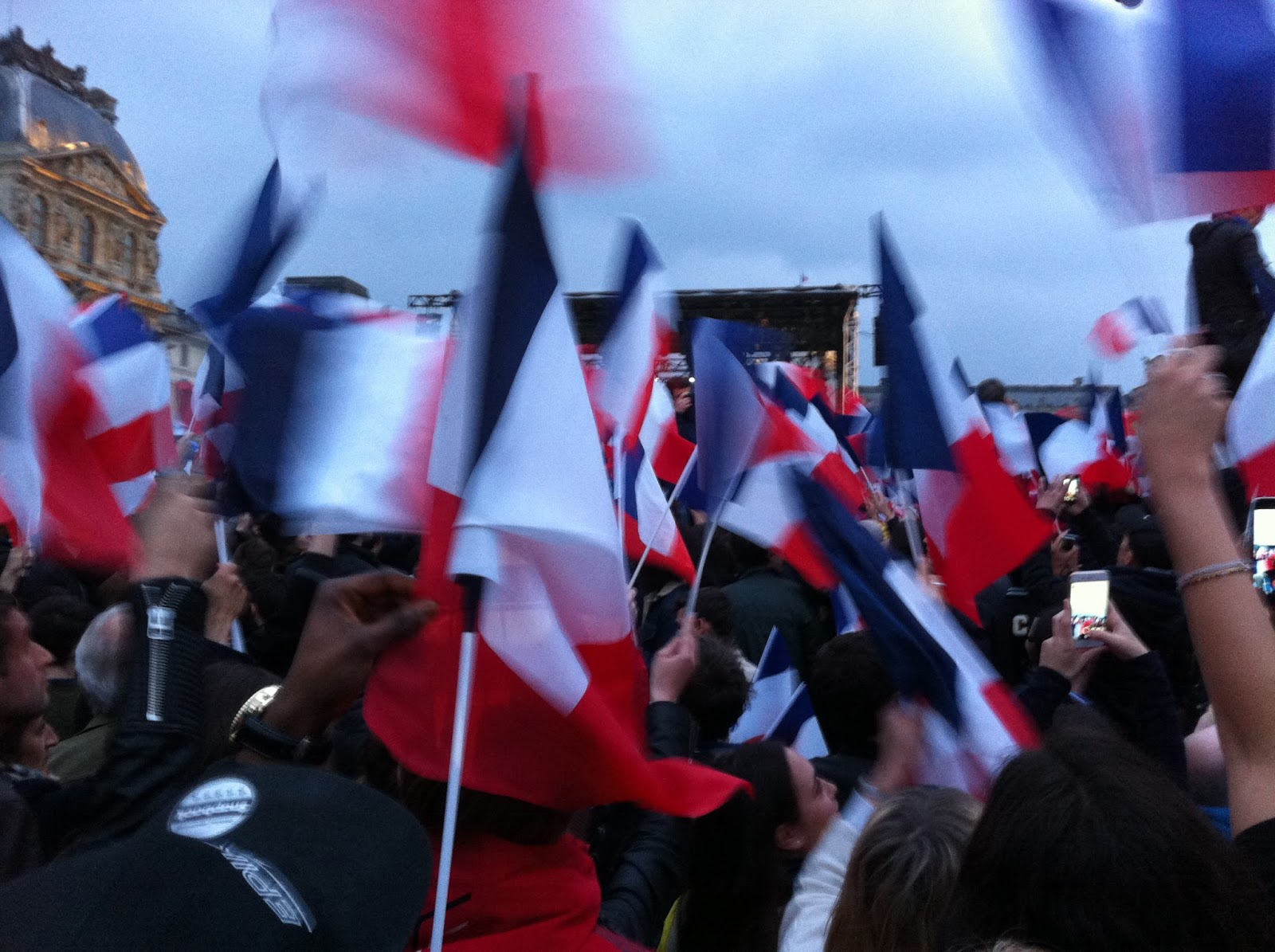
It's almost a miracle, how in just one year, centrist Emanuel Macron and his supporters launched the grassroots movement En Marche! (Forward!) that not only got him into the second round of the presidential vote, but helped him win. Much of the work was done by folks who hadn't been involved in politics before, including many women, and people of color. Victories in the upcoming legislative elections, when voters are not facing the threat of white nationalist Le Pen, will hopefully confirm that democracy still works in France, and people not tapped into traditional parties can still have a voice if they are willing to knock on enough doors.

Even if they win, France is still at a crossroads. In the first round, almost fifty percent of voters chose a populist from the extreme right or the extreme left. In the final round, anti-Europe, anti-immigrant right-wing Marine Le Pen won thirty-four percent of the vote, drawing in not just voters from the center right, but poaching some from the extreme left. Like Trump, she also benefited from the many leftists who chose to stay home or vote blank and take their chances with virulent white nationalists, rather than vote for a centrist.

At a recent political meeting, Daniel Cohen-Bendit, whose family literally had to hide from the Nazis, blamed the growing power of the racist, authoritarian National Front on the French failure to remember and transmit their knowledge of Nazi atrocities. That's absolutely true, but I also blame the left worldwide for ignoring their own totalitarian past, so that when their candidate gets knocked out, it's no stretch for them to abstain, or even to embrace an extreme right promising to support workers. After all, class trumps everything, from misogyny to racism and the abuse of human rights. And when they say class, make no mistake, it's a white male factory worker they're thinking of.

It started with Stalin, who in the name of that working class, executed a million or so, "enemies of the state" often identified by their ethnicity. He killed another million in the gulags, and deliberately engineered famines that killed another five million, including more than a million nomads of Soviet Kazakhstan, and 3.3 million in the Soviet Ukraine. Poles were targeted, too. According to historian Timothy Snyder, "it was Stalin, not Hitler, who initiated the first ethnic killing campaigns in interwar Europe."

Not that anyone cares. Part of the problem with the left is that they are just as willing to ignore facts as any Trump voter. When it comes to Cuba, for instance, every report about the long-term failure of the 1959 revolution -- the poverty, the corruption, human rights abuses, the racism, and homophobia--has been denounced as fake news. Every voice protesting the treatment of the opposition is dismissed as a CIA plant, or just dismissed.

When I told a dyke acquaintance I'd never vote for the extreme left French presidential candidate Jean-Luc Mélenchon-- a re-packaged Communist-- because he was too fond of tyrants—like Russia's Putin, Syria’s Assad, and Venezuela’s Maduro--she first claimed the media made up those connections. And when I pointed out his recent, lengthy eulogy for Castro, she declared her own love for Fidel. And when I brought up the queers he threw in jail there-- "including my girlfriend," she sneered like I was pathetic for letting concentration camps stand in the way of embracing the Revolution.

Most recently, Hugo Chávez in Venezuela seduced the masses at home and abroad with his fancy Bolivarian speeches. But if you dare explain to someone that the country is now an economic and political disaster where dissidents are jailed, you can't buy an aspirin or a roll of toilet paper, hospitals are closed, people are dying of hunger and there are mass protests where demonstrators across the political spectrum are shot dead in the street… the typical leftist response is, "But they're from The Right, aren't they?"

Call me a right-wing reactionary, but I find this callousness as monstrous as the bloated rage of any Trump or Le Pen, and just as racist. Instead of the exploitation of natural resources and labor, these colonialist revolutionaries worldwide prop up dictators with alt-facts, alt-narratives so they can play out their utopian fantasies. That the ordinary people in places like Venezuela and Cuba might aspire to the same standard of living, the same freedom and human rights that we enjoy in the U.S. or France, is of no consequence whatsoever.

This is playing out in France, too, where the left is determined to thwart Macron's incremental proposals for economic reform. They see only that the rich might benefit, never consider why so many people of color and immigrants who voted Socialist for decades and got nothing, might enthusiastically embrace the social mobility, jobs, and improved education that are largely the point of Macron's plans. I get the idea that they want black and brown people to stay poor and pure, untainted by the privilege or money they themselves inherit, which they often pretend appeared under their pillow, or grew on a tree.

Monday, August 29, 2016

The Queer Kitchen

By Kelly Cogswell

So, I've been trying to write a cookbook for the last couple of years, deluded into thinking it would be a nice, light-hearted distraction from the horrors of politics. And why not? I had a bunch of good Kentucky recipes and decent home cook creds. There was even that summer during college that I did a stint in a professional kitchen at Yellowstone National Park.

I began as a dish dog, and got promoted to prep cook where I chopped about a thousand pounds of onions for French onion soup and made broccoli quiche. The adventure came to a quick and very painful end when I was lifting an enormous pot of boiling pasta, hit the edge of the stove, and tipped it over on myself. Who knew polyester pants could actually melt and stick to your flesh?

After that they shuttled me out of there as fast as they could. The guys didn't like having a girl in the kitchen, and they reassigned me to the gift shop where the most dangerous things I faced were the mice attracted by the huge blocks of fudge. It was too late, though. I was hooked, had learned how to use a chef's knife and cutting board like Julia Child on TV. When my mother or grandmother wanted to chop anything from a potato to a peach they'd hold it in their left hand and cut away at it with a small paring knife in their right. It was a miracle no one ended up with nubs.

For cookbook text, I thought I could tell a few stories like that about my family, and maybe even make them funny. You'd have to, after all. Cookbooks are a peculiar genre in which we all love the mothers and grandmothers that influenced us as home cooks, or even as professional ones. The cooking of our roots is shared without resentment. Healthy recipes are offered without the anxiety, self-loathing and fear that spawned them. If we admit we grew up on fried bologna sandwiches, Hamburger Helper, and canned green beans it is done only with sophisticated irony. In fact, let's have a dinner party with Jell-O salad and tuna casserole slathered with cream of mushroom soup and those crispy little onion rings. A martini will help us choke it down.

I tried to write that way, I really did. But it came off as false. I am as disgruntled in the kitchen as I am in the activist street, and have such mixed feelings about the whole thing it's a miracle that my cakes rise and the milk doesn't curdle. I have an abject fear of getting fat which is partly vanity, but mostly the diabetes that runs rampant in my family. One of my aunts died not long after they amputated both her legs.

And while my grandmother would bring out the baked ham and homemade cucumber pickles on holidays, and maybe a big pan of apple crisp, the rest of the time, she just wanted to boil up a hotdog for dinner or eat cheese and crackers. If she wanted to work all day in a hot kitchen, she could have stayed on the farm, working like a dog, and popping babies. Lord, she was happy when she got her tubes tied after her fourth baby. It was a step up to work in a factory. I think of her when I read about the slow food movement, or some writer hectoring us to get back in the luminous kitchen.

Then there are the cookbooks by black writers who carefully describe the contribution of black chefs to the Southern kitchen, detailing everything from cooking techniques to the actual seeds that they brought along on the slave ships. They celebrate survival and ingenuity, the ability to transform the leavings from the master's kitchen into haute cuisine.

And I can only marvel at how rational yet heartfelt it is, and begin to imagine the writer on Xanax. Yes, I know that "soul" food was reclaimed during the Black Power era, in the same way many of us have reclaimed the words fag or dyke or queer, but doesn't that recipe for mustard greens stick in your craw? Don't you want to throw that okra in my white face? I mean, the food is tasty and all, but doesn't it leave a bitter taste in your mouth?

I often forget just how deep my own grief goes until I step into the kitchen and roll out a pie crust or drop some biscuits onto a pan, and evoke my family and Kentucky, remember how my Southern Baptist mother disowned me for decades. And the preachers and politicians there still wish I were dead. And should that happen as it did in Orlando, would refuse to bury me, or bring a covered dish to my mourning lesbian family.

Monday, May 09, 2016

Vampires, Activists, and the Return of "The Gilda Stories"

By Kelly Cogswell

When The Gilda Stories came out in 1991, vampires weren't such a big thing, and black, lesbian ones were unheard of. But that didn't matter to Jewelle Gomez who at first was just writing for revenge. Cat-call her, harass her on the street and she would rip your throat out -- in a story. Gradually, though, these scenes deepened into a novel that not only changed the demographics of vampire stories, but endured as a lesbian classic, an escaped-slave narrative, and an important work of Afro-Futurism that continues to influence young writers, especially young writers of color.

The story is launched when a young unnamed slave runs away, killing a slave hunter who finds her. Still covered with blood, she crosses paths with Gilda, a white woman and brothel owner, who takes her in. After the girl gets older, Gilda and her companion, a Native American called Bird, reveal that they are vampires, and she willingly enters the life. When the first Gilda dies, this young woman adopts her name, and becomes the second Gilda.

It could have been a series of satisfying adventure stories, with Gilda romping around with delectable mortals, perhaps in a leather bustier, while she slays bigots and rapists. In fact, deaths are kept to a minimum. Older vampires teach young Gilda to take blood without killing, and share something in return: hope, knowledge, health. This is a code of honor that Gomez said she learned as a feminist. "The more power you have, the more responsibility," she told me in a recent conversation.

What intrigued me most about The Gilda Stories, though, was how the novel used the convention of immortality to grapple with time and the nature of social change. After all, vampires don't just suck blood, they live forever. This part of the mythology allowed Gomez to imagine the life of a black, queer woman through almost two centuries from a small Missouri town in the 1920's to Boston’s South End in the Fifties, and the Off-Broadway theater of 1971 New York framed by black liberation and the Attica Riots. In a brief jump to the eighties, we find her with a circle of black lesbian friends.

The book was written at the height of the AIDS epidemic in the U.S., and the final chapters leave us in 2050 where a similar disease is ravaging the world, and only the rich can survive, either fleeing in space ships, or hunting vampires and compelling them to share their immortality.

The ending surprised me. Narratives involving social issues almost always finish on a positive note, as if equality were inevitable, part of some upward arc, and we activists can invoke it with our own chants. "What do we want?" "Justice!" "When do we want it?" "Now!" Gomez though, emphasizes cycles. In fact, in an echo of Virginia Woolf's suicide, the first Gilda chooses to take the True Death just before the Civil War because she can't stand to see more war and destruction.

The second Gilda is repeatedly cautioned by Sorel, one of the oldest vampires, to step back from the mortal world. Just like queers, vampires create their own communities, and families. Keeping her distance is especially hard for Gilda, maybe because she has a vested interest. Gilda may be tough to kill, but she remains black, and queer, and female, at risk every time she enters the public space whether it's a dusty road in the nineteenth century or a deserted street in the twentieth.

When I asked Gomez about this emphasis on cyclical time, she said she'd probably been influenced by her great-grandmother. Not just that she was a Native American, which gave her a different perspective, but that she was born in the 1880's. "Imagine. It was a whole different world. She was trying to make sense of how we got from one place to another." Feminism also taught her that you just don't get everything at once. You have to "chip away at liberation."

Especially if you're a black woman. In the late twentieth century, we see Gilda surprised by her own, persistent anger about "the disappointment that she'd seen on the faces of black women over the years." Not just due to white racism, but to black men with a vision of liberation that rarely included the freedom of women, or LGBT people or Puerto Ricans.

Gomez confessed that in an earlier draft, all the embattled vampires climbed in space ships and left, leaving the humans to deal with their own messes. But when her editor asked her to think about what it would mean in moral terms, if Bird had to give up her land a second time, Gomez decided they had to stay and fight. If there is redemption here, it is that she doesn't have to do it alone, but with her chosen family.

A 25th anniversary edition of The Gilda Stories was released in 2015 by City Lights Publishers.

Monday, November 09, 2015

The State of the Queer Cuban Nation

By Kelly Cogswell

Late in October, a handful of independent activists appeared for the first time before the Inter-American Commission on Human Rights reporting on the state of the LGBTI community in Cuba and asking the commission to pressure the regime not just on behalf of queers, but of any independent group trying to work for human rights on the island.

In the video, they seemed articulate, dignified, and maybe a little desperate, offering quiet reproaches to an international LGBT community that has a blind eye where Cuba is concerned, largely ignoring actual LGBT people trying to speak and work on their own behalf, while seeming to applaud every press release from CENESEX, the government-approved National Center for Sex Education run by the straight daughter of Cuba’s dynastic ruler, Raúl Castro.

Carlos Quesada of the International Institute on Race, Equality and Human Rights, said that the “so-called visibility” of Cuba’s queers internationally was dependent on one name, Mariela Castro and that “it contrasts with the actual situation of the members of the LGBTI community in Cuba.”

Determined to see if they could get something done outside the CENESEX bubble, a coalition of Cuban groups, including the Free Rainbow Alliance of Cuba (Alianza Arcoiris Libre de Cuba), the Trans Fantasy Network (RED-Trans Fantasía), The Foundation for the Rights of the LGBTI Community (Fundación por los derechos de la Comunidad LGBTI) and Divine Hope (Divina Esperanza), a queer Christian Group, decided to conduct their own study of the state of the queer Cuban nation. They prepared a questionnaire focusing on personal experiences of discrimination and violence, and whether or not LGBTI people had basic information about their human rights.

It was an ambitious project, especially for embattled independent groups. "By law, organizations that do not declare their support to the state are not allowed to be registered," explained Juana Mora, of the Free Rainbow Alliance of Cuba, and former member of CENESEX. She let those words speak for themselves, knowing that the commission would be well aware that in Cuba, independent activists and journalists face harassment, discrimination, violence, and arrest. Later on in the presentation, she and Quesada described how queer activists were continually monitored and their research materials seized and copied, routinely denounced as counterrevolutionaries, threatened, and subject to detention and interrogation.

Unsurprisingly, most LGBTI people approached for the study were too afraid, or too disillusioned to talk to them. Mora told the commission that "…in Cuba there's a culture of fear surrounding any discussion of human rights. Because when Cubans hear these words they think you're attacking the government. The other thing is, that since in Cuba there isn't a culture of respecting human rights, many people responded that it was a waste of time, knowing that nobody would do anything about your problems."

In the end, though, they persuaded 150 people nationwide to participate. Of these 26 were lesbians, 81 gay men, 19 bi people, 23 trans women, and 1 intersex. Sixty-six self-defined as white, 28 as being of African descent, and 44 as mixed race. Forty-four were between 15 - 25 years old, 56 were between 26 and 35, and 38 were older than 36.

Their news wasn't good. Despite the CENESEX “circus,” as Cuban queers typically call the institution's displays, violence and discrimination were incredibly high, especially on the institutional level. Eighty-seven said they had been assaulted both verbally and physically by cops, and arbitrarily detained. Forty-five had been discriminated against in the workplace, harassed or fired. Sixty-seven had experienced violence within their own families, including being thrown out of their homes. Violence and discrimination, both within and without the family, was worse the further you got from Havana. Cops regularly blackmailed and extorted rural queers. Worse, if they fled to Havana, they risked constant harassment and extortion by cops there and were often deported back to their place of origin. Trans people faced the worst of the violence and discrimination, especially if they were of African descent.

Mora testified that in general, very few of the people polled knew about international human rights instruments, or worldwide advances in LGBT rights. Few had access to resources or support on the island, especially in the areas of work and education. No statistics were kept about homophobic or transphobic murders. Few victims of violence even reported assaults because they weren't investigated, much less solved and prosecuted. "Nothing happened to the guilty. In only one highly public case was the murderer punished."

Sisy Montiel, coordinator of the Trans Fantasy Network, testified that she had become an activist because she herself was the victim of discrimination and violence, and as a young person was arrested so often for being "ostentatiously effeminate in public" that she barely finished high school.

She eventually got sex reassignment surgery, and found work in the theater, but many others like her were forced into prostitution, or killed themselves, literally encouraged by the state to end their lives. Things weren't much better now, she said. Kids are harassed so much in school they either leave or are expelled. Which meant they couldn't go to college or get decent jobs, usually forcing them into prostitution. Discrimination prevented most from getting medical care. Access was made even worse by racism, with black trans people being refused hormones and surgery.

After screening a short film, "Situation of LGBT population in Cuba, 2014-2015," they offered a list of recommendations, which again emphasized the need to pressure the Cuban government to respect independent organizations and civil society in general, and LGBT groups in particular, exposing how social change of any kind requires the same basic rights--to meet and assemble peacefully, to express themselves, fundamental rights that Cubans simply don't have. Not yet.

The Cuban government declined to participate in the hearing.

Monday, September 14, 2015

Hating Kim Davis

By Kelly Cogswell

Good ole Kim Davis, how we love to hate her. Long after she got sprung from jail, and same-sex couples were issued their marriage licenses, it's still Kim Davis as a lead on half the gay rags of the country and beyond. Mostly because she's so easy to hate. She's a woman, after all, and from rural Kentucky.

Her garden-variety bigotry gives you license to make jokes about hillbillies and incest, rednecks and Possum Bottom Kentucky Honeymoon Lodge and Bait shop. You get to rant smugly about her stupidity and backwardness and ignorant accent, and even declare that she shouldn't be sent to prison because it was bad enough that she already lived in "the soggy backlands of Rowan County, Kentucky."

And when you get tired of Kentucky-bashing Kim Davis you get to ridicule her body and her hair, and her four marriages to three men which allowed one self-declared Christian gay man the opportunity to frame an attack on her femaleness as a battle against hypocrisy, declaring, "God bless the whores who love multiple penises up their worn out holes…" and "cock-hungry crevices" to the delight of his "progressive" Facebook friends.

Women are participating too, in the same way former southerners are first in line to sneer at redneck hillbilly pervs. I quit reading articles about Hillary Clinton sometime in 2008 when lefty dykes would join the men ostensibly going after her politics, but mostly attacking her shrill irritating voice, and her incompetent hair, and her childbearing, ball-breaking hips. In fact, they wrote similar attacks against Sarah Palin, who shared none of her program, but all the same shameful equipment.

I also don't read what most "progressives" have to say about Southern politicians because there's always gonna be some line in there equivalent to "Go BACK to the part of Amerikkka that hatches bigots by the hog full… GIT!!!" Because apparently there are no bigots up north. Or out west. No homophobia. No racism. No ignorance. No religious fundamentalists. No dead queers, no cop bigots.

And by extension, the hillbilly heaven of the south has only those things. There are no large liberal swaths, or restaurants where black and white middle-class couples might all go for brunch. Or book fairs arranged by committees including black and white women that might welcome a dyke like me. In fact, by implying the south is exclusively comprised of white ignorant hillbillies there are no people of color at all, except I guess for a handful of morons waiting around to be the next certain victim.

You have to wonder where they all went, the growing numbers of immigrants, of Latinos, of Asians, but especially the African Americans who produced the likes of Martin Luther King Jr. and now a huge crop of anti-AIDS activists that you've probably never heard of like Dr. Joyce Keller. Or Gina Brown. Who don't count at all in how we perceive the south because they are black, female and alive.

Every time I see this kind of South-bashing, I can hear the pathetic little voices after the 2000 election blaming us for the democratic loss, and asking why those idiot inbred hillbillies never vote in their own interests. Maybe we are. Maybe it was your own smug, bigoted assholery that sent poor people, and women, fleeing to the Republicans. And not just poor white people. And not just white women. Yes, racism is one of the primary reasons that the white working class keeps voting for the 1 percent, afraid those nameless hordes are gonna get their jobs, or their homes or their women. But your classist, regionalist sneers do a pretty good job of alienating a wide range of people.

In fact, the current Kim Davis-bashing has almost as much to say about hating people of color and immigrants as it does about southerners, not to mention women. Not just because the jokes and rants have managed to erase people of color from the narrative of the south with all that hillbilly crap. But because the nature of the rhetoric raises questions about just how serious white progressives can be when they support #blacklivesmatter or Syrian refugees or abortion clinics.

After all, if you're so fucking giddy, so absolutely happy to hate somebody with an accent, who comes from a region marked by poverty, who has a vagina, are you only gonna welcome those immigrants who don't make grammar mistakes or too much noise when they move in next door? Or only support the "good" blacks who don't interrupt Bernie Sanders' nice speeches with their shrill and angry demands? What about the dykes, or fags or trans people who refuse to keep to their carefully delineated place? What about all the rural queers? If we step out of line, will you hate us, too? You betcha.

Tuesday, September 29, 2009

Redeeming Caster Semenya

By Kelly Jean Cogswell

I saw the women's 800 meters in Berlin. This young thing was facing the cameras before the race started, pretending to brush a few specks of dust off her shoulders because that's what the other runners were to her, just dust she was gonna leave behind. She wasn't in the lead at first, but pretty soon she broke out and that was the end of it.

Afterwards, the French announcer said, there were two races, Caster Semenya's and the one everybody else was in. She didn't crack a smile. Just brushed off her shoulders again, that young woman from South Africa. Somebody handed her a flag and told her to take a victory lap. She did it sternly. A dyke, I figured. Stone butch and eighteen, with a lot to prove. More than I knew at the time.

It turns out she was waiting for the results of gender testing after complaints from some of the other runners and coaches about her sudden improvement, big muscles, deep voice when she came out of nowhere to win the African Junior Championship.

Plenty of writers blame the complaints on racism and misogyny. And it is always tough for black female athletes. Blogger Monica Roberts wasn't the only one to comment, "I know from my time on planet Earth, if an African descended female athlete excels in spectacular fashion, we get accused of cheating or have 'that's a man' shade hurled at us."

Like many others, she went on to talk about the Williams sisters whose complete dominance of the women's tennis circuit has brought on a lot of the same complaints. "They're too big, too strong. They're not real women." She also reminded us that Olympic champion Maria Mutola of Mozambique faced the same kind of accusations despite passing test after test.

Masculine women, and dykes, of course, get that nonsense all the time, no matter what their race. Martina Navratilova was in the hot seat for her muscley arms and total control of women's tennis a generation before the Williams sisters. For the rest of us, our girlness started getting called into question when we were little and beat boys in games.

All that makes a black, butch woman with wings on her feet fair game. And the medical juries are in. At least the information was leaked. Caster Semenya wasn't doping. But she is a "hermaphrodite" as they wrote in some headlines. Intersexed from those that wanted to be polite. No external male organs but reportedly testes hidden up in there.

I can't imagine what she thought, finding out in the morning paper, and looking down at a body that's suddenly foreign. Worrying everybody thinks she's a freak. Wondering if they'll let her compete again. If she can stand to.

The only good that's come out of the mess is that it gave birth to a couple of interesting articles about biological complexity explaining there are far more gender variations than we acknowledge both on the hormonal, biological and genetic levels. Hell, X's and Y's are scattered around like party favors.

Unfortunately, few of the articles went so far as to demand Semenya be accepted as an athlete, no question, by clarifying what matters most to her, that in terms of performance, most intersexed females with testes don't get enough of a handy hormonal spike to get any kind of advantage.

In fact, women with "normal" sex organs can produce unusually high levels of testosterone. What are we going to do about them? The only fair thing would be to test all the "female" athletes and establish one set of rules for everyone. Maybe even enforce them by administering hormones until they're all at exactly the same levels. Perhaps the tall ones should be shortened and the short ones stretched.

According to Peggy Orenstine, the Olympic Games quit gender-verifying female athletes in 1999 because it was proven the few women with atypical sex development didn't actually get a competitive edge. Worse, "it served only to humiliate them." Given that, it's hard to understand why the International Association of Athletics Federations continues to go after Caster Semenya.

The only challenge to Caster should be the field of runners. Unfortunately, besides the IAAF, there's now the emotional obstacle of stepping back into a stadium, and competing in front of a crowd when plenty of them are thinking she's a freak of nature, and not just because she blew away the world champion by almost two and a half seconds.

After the news broke, she withdrew from her next race and apparently began trauma counseling. I only hope it's coming from somebody kind and open-minded who won't stuff her into dresses, or try to extract her difference with a knife. I can't wait to see her run again. That beautiful burst of speed and defiance. Leaving all the other girls in the dust.

Tuesday, November 18, 2008

Stone By Stone, Destroying Jericho

By Kelly Jean Cogswell

It's not just a theory. There really was a Mormon conspiracy to suppress same-sex marriage in California. Michael R. Otterson, a P.R. guy for the Latter Day Saints came clean to the Times. "We've spoken out on other issues, we've spoken out on abortion, we've spoken out on those other kinds of things... But we don't get involved to the degree we did on this."

All I have to say is... Thanks. Really. We owe you one. That ass-kicking of queers at the polls jump-started a dying LGBT civil rights movement, and got us on the streets en masse for the first time since Matthew Shephard was killed in '98, for the first time since ARV's demobilized the AIDS movement.

Thank you, thank you, thank you, Mr. Otterson. Without you and the masses of fundamentalist bigots, a million queers wouldn't have answered the Join the Impact call to demonstrate last Saturday. They wouldn't be planning for next month. And the one after that. If you hadn't dumped gasoline on what wasn't much more than a smoldering cigarette butt, we may never have caught fire.

Hell, we'd still be relying on campaigns like No on 8 run by salaried queers that erased us from ads, kept us off the street, and ignored communities of color in California. Without you, we'd still be indentured to the Democrats and their gay-hating, vote-gathering preachers because they're the only game in town, or were. Not any more.

Now, we have each other. We've started to feel our strength again. One young queer wrote Andrew Sullivan to say, "For younger gays, this is the first time we've had the chance to take to the streets and fight for our basic humanity. Now that we've gotten a taste of what it feels like, I don't think we're ever going to give it up."

I hope not. That feeling is why I've stuck it out. Why so many of us have. It's what street activism gives you. That sudden overwhelming sense of unity, of pride. Of feeling your voice and your life amplified by a hundred, by a thousand, by ten thousand every time you step into the street.

Enjoy it. Protect it. If there's one thing I know about civil rights organizing, it's that you can knock your head against that wall for years, but if elements don't converge, nothing rises. I think it was Obama's historic victory converging with our defeat at the polls that gave us the short, sharp, shock we needed to rise. And in Minneapolis and Nashville, San Diego, Missoula, Boise, Evansville and Honolulu, in Seattle, San Francisco and New York, you can feel the walls trembling.

All we have to do is keep our distance from corrupt queer leaders who whisper, "No, you can't." Or "Not now. Maybe later." "Not like that." "You really need an expert." Let them take their CV's and amnesia elsewhere, those who have forgotten that rights aren't negotiated in backrooms by ghosts, but seized with both hands in the street.

And now's the time, no matter what you think about marriage itself. I admit I was reluctant. For most of Western history, and Eastern, too, marriage was essentially a contract for men to buy woman like breeding cows. My mother's mantra was equally discouraging: "If only I hadn't married your father and had you kids."

Deeply ambivalent, I may have sat this battle out if California hadn't slammed the door so emphatically in our collective faces. Now, I don't have a choice. Change, like god, moves in mysterious ways. The black civil rights movement didn't begin with a vague call for equality, but with Rosa Parks and the Montgomery bus boycott.

Probably some activists didn't care much about where they sat. The miracle of activism is that symbols emerge, chosen or not, and it's the fight for them that rearranges the terrain like an earthquake. And like bus seats and lunch counters, marriage is suddenly the battleground that counts for LGBT civil rights and our growing struggle against the bigotry of religious fundamentalism more and more embedded in the state.

To win, queers must stick together, and welcome support when it comes. In California, a coalition of Asian, black and Hispanic organizations are already submitting a petition to the California Supreme Court to overturn Proposition 8.

On Monday in New York, the city's largest Spanish-language daily, El Diario La Prensa, printed an editorial supporting same-sex marriage, firmly reminding the Latino community they had their own lesbians and gay men, and just as firmly reminding queers that LGBT people of color fight on more than one front. "The gap between the struggle for LGBT rights and the struggles for economic and racial justice needs to be closed."

Maybe it finally will be. Change is coming. Like a wave, like a trumpet blowing.

Tuesday, October 07, 2008

Economics 101

By Kelly Jean Cogswell

I spent half of yesterday in front of MSNBC watching the market crash in slow motion, first dipping below 10,000 then sinking bit by bit until something like 800 points had been lost.

An hour before the closing bell, there was a small rally as traders dove in reflecting optimism about a global interest rate cut, or maybe they just snatched up some bargains because even blue chip stocks like Coke had lost a good chunk of their value. Hell, what do I know?

I've been haunting economic sites since the disaster interrupted our Palin feeding frenzy. It's like visiting a foreign country with its own language and rules, or deep sea diving where you can apparently get so turned around in the murky depths there's no way to know which direction is up except by watching the bubbles of your exhaled breath.

What I knew before about the workings of the market could fit in a teaspoon. Now, I think I could fill a whole Grande Caffe Latte cup from Starbucks, which by the way is not riding out this storm too well. They've closed a ton of stores, especially in Australia.

Nobody agrees on anything. Experts say 1) the big bailout (rescue) was not perfect but better than doing nothing, or 2) it will have no effect whatsoever, and it was a big mistake when we are going to need the money for a social safety net.

Likewise, they say that 1) the disastrous economy is going to last several months before gradually improving, or 2) life as we know it is completely over and pretty soon there'll be people selling apples by the side of the road, and not just the Greenmarket.

Everybody agrees we're in trouble in the short term. Except, maybe, for the Masters of the Universe ensconced in their Greenwich, Connecticut homes, people are going to be sliding from the upper class down to the middle where there will be plenty of room, because the middle class is sliding right down the coal chute straight to hell.

The upside is, Russia is too broke to start more wars, and maybe now it will finally be time for that nationwide dialogue about class I've been waiting for since 2000 when Ralph Nader nattered on about it in his failed presidential bid, and the anarchists were busy busting up the WTO in Seattle. Remember that?

These days, you only hear about class when the Republicans accuses Democrats of trying to start a class or culture war, though the Dems themselves only dare refer to it couched in the euphemistic language of "income disparity" or "economic interests." As in, "why don't those red state morons vote their economic interests?" Perhaps your snotty tone explains why.

The current Democrats, like Nader's Greens, have about as much understanding of working people as the Salvation Army types in Brecht's play, "Saint Joan of the Stockyards" (1931), who didn't understand why their offer of free soup, nice music, and haranguing calls for salvation didn't have a long-lasting appeal to the desperate.

I caught the play last Tuesday. It seemed contemporary, all the masked greed, manipulated economies. Especially, the character of Pierpont Mauler, speculator and meatpacking plant owner riding high, higher, highest until he sinks like a stone only to be welcomed back into the market by his friends and victims; things wouldn't be the same without his bright ideas. No such redemption for the poor people of the play like Joan Dark, who ends up dead of illness and hunger in the middle of a snowy Chicago street.

While we're not quite there yet, the play reminded me of the elephant in the room, that even now, in the midst of the current mortgage crisis and total economic crash we're still limiting our vocabulary to "Wall Street" versus "Main Street." There may be questions of greed, vengeance, loss, but nowhere do you find words related to "class" unless it's paired to Middle.

It's like trying to analyze the impact of hurricane Katrina, or police brutality or profiling without the words "race" or "racism." Though maybe the word "class" is irrelevant or outdated. The cognoscenti say we're post-race, and post-gay, even if queers are still blamed for everything, from the Trade Center attacks, Hurricane Katrina, to this current mess, which Barney Frank apparently caused having a homo affair a decade ago with one person associated with Fannie Mae mortgages.

On the other hand, maybe "class" analysis won't work because almost everybody in the U.S. sees themselves in the same middle one, from rich, multiple home-owners to the poor who are always just one job, one university degree, one generation away from the illustrious Middle both ends are played against.

Maybe, in fact, there is no poor, no rich at all. In America 2008, there are just "differently leveraged," all hedging their bets.

Visit Kelly Sans Culotte at http://kellyatlarge.blogspot.com.

Tuesday, September 30, 2008

Identity Politics, Bankrupt?

By Kelly Jean Cogswell

Remember that scene in Star Wars where Luke Skywalker, Princess Leia, Han Solo and Chewbacka are trapped in the garbage compacter room and barely escape as it closes in ominously on all sides?

That's the perfect metaphor for Identity Politics 2008 -- all of us minorities trapped in a shrinking box of trash in which the crushing walls represent not just society, but community inquisitors demanding our qualifications. Are we gay enough, black enough, female enough to deserve liberation?

This week, the sacrificial queer was Mike Buse, chief of staff of Senator John McCain. Mike Rogers outed the guy on his blog, while encouraging a call-in campaign to the right-wing group Focus on the Family asking readers to "thank them for supporting John McCain even though he has gay Americans in high places on his staff, including his chief of staff."

You can imagine the outraged fundamentalists, the angry phone calls to the McCain campaign, all the homophobic hate generated against Mike Buse. Maybe next Rogers'll get a list of McCain staffers of color and encourage people to call the John Birch Society. Hell, why not call the Klan if it'll help bring down McCain?

Just a couple of weeks ago, a huge wave of so-called feminists unleashed their misogyny and hate against Sarah Palin, attacking not just her politics, but her very existence. Wendy Doniger's Washington Post article declared that despite her baby-producing womb, Palin's "greatest hypocrisy is in her pretense that she is a woman..."

The National Organization for Women's Kim Gandy actually issued a press release announcing that "as the chair of NOW's Political Action Committee, I am frequently asked whether NOW supports women candidates just because they are women. This gives me an opportunity to once again answer that question with an emphatic 'No.'"

Apparently it's the "National Organization for Only Those Women Who Agree with All Our Policies."

I'm not above bigotry-tinged sneering myself, dismissing the 2000 Republican National Convention packed with black faces, and Bush's "Cabinet of Color" as mere sideshows to attract black and Hispanic voters to the Republican Party. I nodded in agreement when I heard Colin Powell or Condi Rice get called Oreos and traitors by other people of color.

At the time, it didn't bother me when black Maryland conservative Michael S. Steele was pelted with Oreos, called an Uncle Tom, and portrayed as a black-faced minstrel during his 2005 bid for U.S. Senate. No problem, said black Baltimore Democrat, State Senator Lisa A. Gladden. "Party trumps race, especially on the national level." Except when, as earlier this year, it's Jesse Jackson accusing Obama of talking down to black people and "acting like he's white."

Stanley Crouch, an African American writer, thinks the greatest threat of identity politics is that it blinds participants to context and interconnectedness. We don't see the national debt, the dangers of selling out to corporations or unions, or the problems of competing with China and India in the global marketplace. "Though they live in the United States, those are not their problems. Identity politics is independent of our common fate as Americans."

Increasingly, I think the greatest problem in identity politics is that most of the focus these days is on the "politics," claiming territory, enforcing ideologies, and excluding anyone whom the gatekeepers determine don't meet the one or two acceptable ways to be gay or black or female.

We dispense with "identity" any time it's inconvenient. In fact, we are disturbingly comfortable using tools of bigotry against each other like when activists like Mike Rogers (and Michelangelo Signorile) incited homophobia against McCain's gay staffer or when black Democrats throw race-based insults at conservative politicians of color.

Feminists refusing to acknowledge Sarah Palin as a woman incite misogyny against all of us and create echoes of those times dykes (and poor women, and women of color) have been excluded from the women's club. Frankly, NOW still prefers we pass. Mouth the right platitudes. Never admit to having shot at squirrels with a BB gun. Pretend that our primary issue is abortion.

I'd dump the cesspool of identity politics if I could. The conundrum is, to end prejudice, and make change in society, there's no other choice but to suppress our individuality and organize around that artificial "identity," even if the color of our skin, our reproductive organs, or sexual orientation hide nearly irreconcilable differences.

To succeed at all, we need to start from scratch, reject politics, reject hate, find our few inches of common ground, plant respect there.

Monday, March 24, 2008

Screw Unity, Save America!

By Kelly Jean Cogswell

I'm definitely a freak. There's a drum beating out there and I'm no where near in step. In fact, I don't even hear it. Just a dripping in the kitchen sink that calls for a plumber rather than some political savior like Obama.

I finally managed to have a look at his recent speech on race after reading glowing reports from both sides of the aisle. Expecting to bask in the warm glow of his great vision for America, I felt my skin crawl at his insistence on unity, unity, unity.

In my experience, unity usually translates as "Shut your trap, Bitch," or more nicely, "We'll get to your issue when we've solved the really important ones. It's just not the right time." Funny, the right time never does come.

After all, isn't unity what we've had under Bush? The minority Democrats voted in lockstep with Republicans for an Iraq War which is now costing us $5000 per second, burdening a family of four with about $330 per month, a failed economy, not to mention dead American relations, whole cemeteries of Iraqis, and a Middle East that may well be destabilized for generations to come.

Then there're the boatload of democratic perversions in the name of Homeland Security like wire-tapping, racial profiling, oh, and Guantanamo, that have continued even with a Democratic majority in Congress, all because we have to be unified to fight that endless War on Terror that has as many definitions as that soporific word, "nice."

Obama, above all, seems like a nice man. His heart is in the right place wanting to welcome everybody into his big tent, though I still balk at his campaigning down South with the same black preachers that Bush used for their popular rabble-rousing and money-raising capability. You just have to ignore their hellfire and brimstone conviction that all us queers are going to burn eternally. Come on in.

I get the idea he just can't abide anger. Not that he doesn't understand it. In this speech, Obama gives one of the more passionate defenses of anger in black and working class communities that I've seen, citing its deep roots, the damage it can do, how it can embitter, paralyze and blind. All true, including the fact we have to see past our anger to find solutions.

The problem is that he'd be happier if we put our anger entirely aside. It "... is exploited by politicians." "It distracts attention from solving real problems; it keeps us from squarely facing our own complicity in our condition..." "Just as black anger often proved counterproductive, so have these white resentments distracted attention from the real culprits..."

He's forgotten, or never knew, that anger is one of the few things, maybe the only thing, that gets us into the street. Fury about injustice was what sent Jesus on a rampage in the temple knocking over the tents of moneylenders. Anger freed Malcolm X, ACT-UP, the Lesbian Avengers. It is an essential engine for change.

I am afraid we Americans are not angry enough, and that insistence on unity will lead to a white-washing of the past eight years, skipping the justice stage for reconciliation, and leaving Bush's damage intact.

No one except the grunts will be responsible for the men and women we've tortured in American prisons. No one will be responsible for lying about the imaginary Weapons of Mass Destruction that got us into Iraq, or for deregulating the banks that are self-destructing, preaching the hate that translates into dead queers, refusing jobs and basic respect to people because of their accents or skin.

I find rage coordinates nicely with the Timberlands I wear to demos, though I understand the exigencies of politics. You can't only work from the margins, though it's the best place to be an activist. Politicians have other needs. To them I say, "Forge alliances if you must, hold hands, sing Kumbaya, but keep your eyes on justice."

For that reason, I'm wary of Obama. I'm troubled by how easily unity translates into silence and amnesia, and hope into absolution. I'm afraid of his Christian rhetoric that makes it seem like his victory is sanctified by Jesus, a manifestation of divine will, and genetics. "...Seared into my genetic makeup [is] the idea that this nation is more than the sum of its parts – that out of many, we are truly one."

In Obama's America, what will happen to those of us that are part of the devil named Multitude, and insist on dissent? How will we be labeled? Will the censorship that was imposed by Bush and the Republicans in the name of patriotism and fear, be replaced by that other American fascism of Niceness, Unity, and Hope? Will anybody have the guts to speak the truth?

Tuesday, January 15, 2008

Election 2008: What Divides Us

By Kelly Jean Cogswell

It's not enough to worry about race and class and sexual identity this election. In New York there's also sheer and unmitigated stupidity -- the poll workers who resent it when you interrupt their early morning donuts and force them to wipe the sugar from their hands, open their ledgers and let you sign. Then there is the outdated and misleading information at voting websites and phone banks.

Last week, I called the General Election Board and asked if I could vote there because I'd be out of town. The woman said yes, so I hopped on the subway, and turned up at the office where a row of flabbergasted men told me I was nuts. "For that you have to go to the borough office. They're closing any minute. How long are you here?"

When I finally got to the next place on Varick Street, where you had to have serious ID before you could even go upstairs, there was a woman trying to change her party affiliation to Democrat. "I'm either Independent or nothing. They told me I could do it until the 15th."

The guy argued with her for ten minutes, but it became a moot point when he went back to check and she was already registered Democrat. From 2003. "I don't know why they couldn't have told me that on the phone when I asked," she complained.

I had an easy time voting, but we commiserated going down in the elevator. "It's discouraging," she said. "It's like they don't want people to vote. What if you were a new citizen? An immigrant? This would all be so off-putting."

Not for her. She spoke standard white English, was dressed to the nines, with café au lait skin. I wondered what her background was. When it comes to voting, there's a world of difference between African Americans and Latinos. I guessed first generation Dominican but couldn't bring myself to ask.

The atmosphere surrounding race is changing again in the country, and not for the better. It's a little like after the Diallo shooting when there was mutual defensiveness and hair-trigger tempers among New Yorkers. It was justified then. But the recent exchanges between the Obama and Clinton camps are almost as bad, and any truce they may have come up with doesn't hold with the rest of us.

It's not easy to deal with race in America. And I'm still worried when I hear Obama insist that skin is something more than a temporary bridge, or his campaign imply it's some kind of guarantee against racism. Which is what they must have thought when they briefly attempted to cast South Asians as economic bogeymen this summer, demonizing Indian contributors to Clinton, and invoke robber barons who "laid off American workers to hire Indian techies."

Obama apologized of course and washed his hands. That's politics. All the dirty tricks in the book. And the press is just as happy as anybody else to jump in, managing to insult almost everyone by explaining Hillary's sudden surge in New Hampshire with the fact that she cried and got the female pity vote, especially from uneducated whites with lower incomes -- in other words, all those who were too ignorant and racist and stupidly feminist anyway to vote for Obama. Another bridge burnt there like a candle to the joys of America.

Anybody'll say anything. Sometime or other a Clinton staffer actually called Obama "uppity". Clinton's remark this week that MLK needed LBJ to solidify social gains, though somewhat true, was about as graceless as what inspired it -- Obama climbing onto the pedestal and declaring himself the next Martin Luther King. What a bunch of buffoons.

A truce may help them out of the election, but the scuffle is a sign that America's still in the same old mess. And once again putting black and white folks at the center of the debate about race to the exclusion of everybody else. So much for Hispanics representing one in eight residents in 2000, and slated to be one of four by 2050.

No wonder Hispanic voters don't see Obama as a bridge to anything, partly because they don't recognize his name but also because a dark skin doesn't mean much when they're consistently left out of the equation. Clinton gets points because of her husband, but she shouldn't count her chickens either.

In general almost half see themselves as independent and vote that way. Last time it was for the family values of Bush. This time, Latino indies are leaning more toward the Democratic side, especially after the Republicans' recent immigration laws, and the Iraq War fiasco. There's no perfect choice.

Voting may be a hassle, but nothing is more off-putting in politics than politicians.

Tuesday, December 04, 2007

Breaking the Silence In Newark

By Kelly Jean Cogswell

In the Sunday New York Times, there was an article about queers in Newark, and the delights of the virulent homophobia they face, including verbal harassment, violence, political bias, and scorn from the police, but no mention at all that the city is eighty percent African American. I guess it was enough to show the photos -- all black except for one Hispanic guy.

Why skip that detail in a portrait of the city? Because somebody might accuse the writer of implying that black people are more homophobic than whites? Or because nobody wants to admit that we don't all share the advances of the LGBT community that pundits like Andrew Sullivan keep declaring passé?

Newark is just a couple of miles from Christopher Street, but the activists there might as well be in Zimbabwe for all the support they get. Since Sakia Gunn was murdered four years ago, queers have been trying to get a LGBT center established, but have had no luck maneuvering through the politics at city hall, though Mayor Cory Booker did manage to get a rainbow flag hung last June earning himself a flood of hate mail. Zimbabwe, at least has the eyes of the world. Who's watching Newark?

Laquetta Nelson tried to get a PFLAG chapter started and couldn't get anyone to turn up. I've spoken to her in the past. She's a persistent woman. If she can't fill a room, it's because many people just aren't out, not from political reticence, but because they're afraid for their lives.

I know homophobia in Newark is complicated by other problems. The city's drawing new businesses, new arts centers, but the neighborhoods are a mess. There are gangs, and drugs. Nobody's safe. But why is it always us that has to wait? Why, a few miles from wealthy New York, are Newark queers so poor the only place they can have to themselves is a drop-in center in some crappy building on the outskirts of town where everybody coming and going is so vulnerable they don't want the address printed? Forget the comfort of gay bar, or a neighborhood like Chelsea.

Queers looking for company, for community, have to leave home, cross the river like the young women who tried to leave behind all that hate and violence, but found it renewed in the person of Dwayne Buckle. When they defended themselves and cut the guy, who got busted? Who's sitting in jail? Where is our community for them?

Sometimes I want to scream at all the professional "activists" in New York and San Francisco with their fresh scrubbed rainbow of faces and ask if they remember what it's like to struggle? For many of us, things like gay marriage are just icing on the cake. Plenty of us haven't had the main course yet, aren't even at the table.

It often comes down to class, the thing we Americans are terrible at. We can fill a room full of all kinds of skin tones, but when we open our educated mouths the diversity seems just an illusion.

And the queers in Newark aren't just black, many are poor. The article didn't really say that either, just that queers had to grapple with poverty in the city as if it weren't their own.

Maybe that's embarrassing, too, to describe someone as poor. Instead, one twenty-year old man was "homeless and jobless ... effectively orphaned." Avoiding words like unemployed, abandoned, broke, his condition sounds temporary, almost like a choice.

If only it were enough to wrap people in the cotton wool of civilizing language. If only by refusing to use the word "black" you could erase the tentacles of homophobia entwined in African American culture and pretend like it doesn't take some extra effort to yank them out.

Though maybe the writer, if he didn't want to get published in the New York Times, would be seething with rage, his words burning holes in the paper. Still, those gaps of silence are disturbing. They hide the truth of things, the roots.

Homophobia is everywhere, and everywhere has grafted itself onto the culture of the host like a parasite mutating to protect itself from changes in other victims nearby. Things have changed for middle-class urban whites? Don't count on the same for trailer trash.

And like athlete's foot loves the humidity of the locker room, homophobia loves the sweltering air of religion, whether it lives in a mosque or Pentecostal storefront or cathedral with spires reaching towards the sky.

Lucky Newark, the first black presidential candidate thinks it's okay to pander to homophobic black voters by welcoming anti-gay preachers into his Big, All-embracing, Non-partisan, "I'm a Better Feminist than Hillary" Tent. Do I hear an amen, brother? Pack your bags. We've been sold down the river again.

Visit Kelly Sans Culotte at http://kellyatlarge.blogspot.com

Tuesday, March 27, 2007

Celebrating International Immigrant Bashing Month

By Kelly Jean Cogswell

798 words

It's March again, and time to celebrate International Immigrant Bashing Month. Take your pick of dragging away elderly Chinese men when they pick up their grandkids after school in Paris, or yanking women from backpack factories in Massachusetts.

If that doesn't do it for you, follow the advice of New Jersey deejays and report your neighbors to the INS if they have so much as the whisper of an accent. They're taking your job, goshdangit, they're "invaders," fight back.

From Marseilles, France to Hazleton, Pennsylvania, where the mayor is bringing suit to purge the place, you can work with likeminded folk to enjoy the benefits immigrants bring, without actually paying for them. Bash an immigrant today!

Not amused? That's pretty much the message of the right-wing from Europe to the U.S.

If you listen to the left, all you hear is a whole lot of nothing. That is, until elections roll around. In the U.S., now, there's a half-hearted attempt by both sides to naturalize a few illegal immigrants and maybe give back healthcare to their newborn American babies without demanding the infants' passports, driver's licenses, and credit history.

The issue is almost as invisible in the non-immigrant LGBT community. We don't have anything to say until a friend's lover is about to be deported, or for a few brief minutes when some Iranian queer is about to be sent back to face the hangman's noose. Never mind that plenty of us immigrate for the same reason as everybody else, bread and freedom.

Sometimes I get the idea we think it is, well, impolite to talk about immigration, racist even.

That delicate, magnolia blossom sensibility of noninterference means that the only people talking about immigrants are the crapules on the right that essentially want slaves to pick up their garbage, pluck their chickens, clean their hospitals and schools (but not use them), and never, ever open their mouths.

I'm not a radical opener up in terms of national immigration policies, believing neither in drawbridges and moats nor absolutely free entry with no requirements whatsoever. The issues are complicated. Social services ARE expensive. A rapid influx of immigrants CAN change the whole character of a previously homogenous community or nation, forcing them to grapple with tough issues.

But in economic terms alone, most "developed" economies would spit at the seams without immigrants, and democracies owe it to their ideals to offer refuge to at least some of the neediest, especially when it is first world wars that have screwed up their lives -- Iraq ring a bell?

What concerns me most is what happens to people both legal and illegal that have already settled in a place.

Except maybe for the very young, immigrating isn't something you do on a whim. The journey itself is often grueling, dangerous, and expensive. We've all heard reports about things going wrong in the crossing of Mexican deserts, or in the dark, airless container ships from China.

In Northern Africa, people gather from all over the continent to pay an enormous amount for the privilege of climbing into an open leaky boat and setting sail for any rocky beach considered Europe. A lot of people drown. That's desperation.

Once you finally get to a place like L.A., or New York or Paris, there's a chance for humiliation and harassment every time you go out the door. Maybe it's your race, or the way you walk. God knows opening your mouth is an ever present source of danger.

It's a little like being queer. Remember in the old days, when the typical explanation to bigots claiming gayness was a choice was a detailed list of the obstacles we face followed by the question, who really would choose that? -- the torture in schools, gay-bashing, discrimination in jobs and housing?

Immigrants have their own balance sheets. You may gain economically, live a less dangerous life (unless you get stuck in the ghetto, or beat up by cops, or die in transit), but you give up a lot, too, hearing your language around you, being able to express yourself or defend yourself, knowing the customs, playing a role you understand, having respect, family, a real identity, not to mention the land itself.

In places like Little Havana in Miami, if you could draw back the curtains of some of the houses you'd find old men sitting motionless on the couches with stunned looks on their faces. I have that same look sometimes in Paris, and the stakes for me aren't nearly so high.

It's far worse for the kids in their teens and twenties who face the opposite. Suddenly deported because of irregular papers, they find themselves in troubled countries where they don't speak the language, have no relatives, no connections, no nothing but the passport.

The real racism is not to talk about immigration, but to turn away.

Visit Kelly Sans Culotte at http://kellyatlarge.blogspot.com.